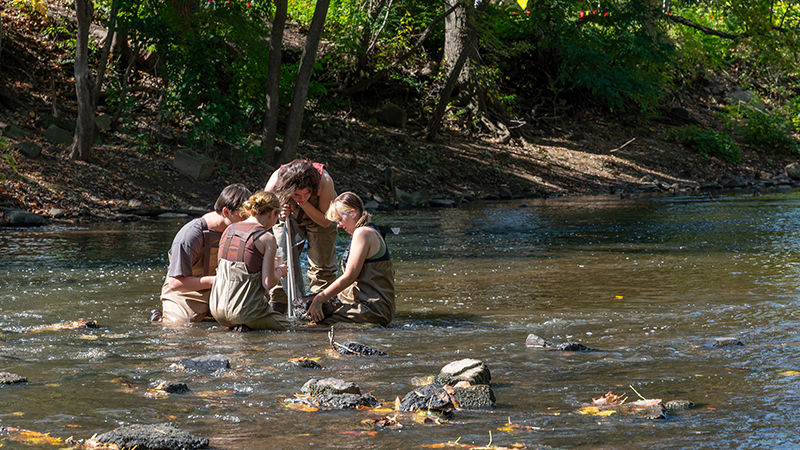
What is applied conservation biology?
Applied conservation biology focuses on analyzing and conserving Earth’s biological diversity. In this major, you’ll pull from the biological, physical and social sciences, along with economics and natural resource management, to understand how to protect ecosystems and the species that depend on them.
What you'll learn
Course work in this major includes:
- life sciences;
- social sciences;
- communication;
- climate change;
- environmental policy;
- field, lab and analytic techniques;
- experiential learning, such as study abroad or professional internships.
Why study applied conservation biology at MSU?
Applied conservation biology seeks to harmonize the relationship between Michigan’s natural resources and the Michiganders who rely on and enjoy them.
As a student, you’ll apply core ideas from wildlife biology and ecology to real questions in wildlife and natural resources management, policy, conflict resolution, resource economics and other public-facing dimensions of the field.
Working closely with state organizations and local communities adds hands-on learning and real impact to your experience.
This major can be a strong fit if you’re interested in the life sciences, social sciences and environmental policy — and you want to prepare for careers in conservation biology, as well as fisheries biology, wildlife biology, animal health and applied ecology.
Specialized concentrations
Students who complete the requirements for the applied conservation biology major and choose elective courses appropriately can also satisfy requirements for certification by the American Fisheries Society as an Associate Fisheries Scientist or the Wildlife Society as an Associate Wildlife Biologist.
Concentrations include:
- water quality;
- forestry;
- resource economics;
- conservation law enforcement;
- environmental education;
- conservation biology;
- wildlife biology and management;
- wildlife disease.
Hands-on learning opportunities
Faculty and graduate students in MSU’s Department of Fisheries and Wildlife lead study abroad programs during spring, winter, and summer breaks.
Study abroad options have included:
- Exploring Wildlife Conservation in South Africa;
- Big 5 African Conservation Internship;
- Cheetah Conservation Internship;
- Marine Biology Internship;
- Rhino Conservation Internship;
- Studies in Antarctic System Science.
Learn more about Fisheries and Wildlife study abroad programs.
Study in a close-knit science community
This major is offered through the College of Agriculture and Natural Resources, where students study everything from food systems to environmental science. You can also choose to complete this major through Lyman Briggs College (LBC), a residential college at MSU that combines science-focused academics with a small-community experience. In the LBC pathway, you’ll take your foundational science courses within Briggs and complete your upper-level major requirements through the College of Agriculture and Natural Resources.
Student organizations and activities
There are over 1,000 registered student organizations at MSU, including:
- Fisheries and Wildlife Club;
- Fishing Club;
- Fly-Fishing Club;
- Birding Club;
- Herpetology Club;
- Outdoors Club;
- Pre-Veterinary Medical Association.
These groups are a great way to meet people, build skills and get involved outside class. And with over 1,000 student clubs at MSU, you’ll have plenty of options to find your niche and your people.
Alumni pursuits
Graduates often find employment with state and federal natural resource agencies; nonprofit environmental organizations; private companies and consulting firms; as well as universities and colleges.
Common jobs include:
- conservation officer;
- environmental consultant;
- wetland monitoring assistant;
- fisheries/wildlife technician;
- land management planner;
- fisheries/wildlife biologist.