Specialized concentrations
Concentrations include:
- aquaculture;
- aquatic biology;
- water quality;
- conservation law enforcement;
- environmental education;
- marine ecosystem management;
- conservation biology.
Also, if you complete the requirements for the fish ecology and management major and choose appropriate elective courses, you can satisfy requirements for certification as an associate fisheries scientist by the American Fisheries Society.
Hands-on learning opportunities
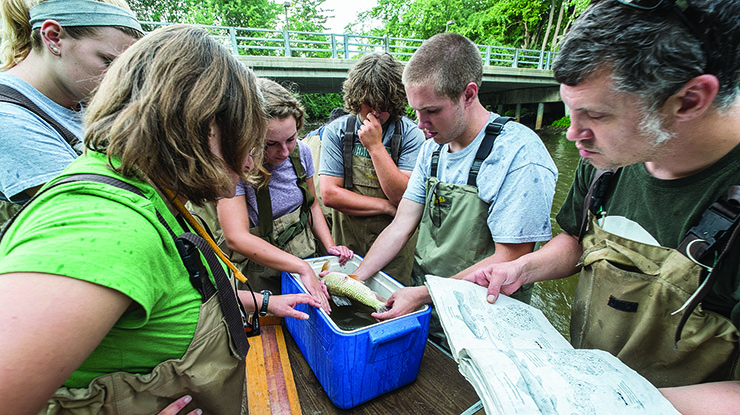
As an undergraduate, you'll have access to experiential learning and real-world research opportunities. You’ll also learn lab and field techniques. There are both volunteer and paid opportunities to get involved, like working on projects that support Michigan’s lakes, rivers and aquatic ecosystems in partnership with local organizations.
Plus, MSU’s Department of Fisheries and Wildlife currently offers opportunities to study fisheries or wildlife in Antarctica, Fiji, Madagascar, the United Kingdom, Nicaragua and South Africa.
This major is offered through the College of Agriculture and Natural Resources, where students study everything from food systems to environmental science. You can also choose to complete this major through Lyman Briggs College (LBC), a residential college at MSU that combines science-focused academics with a small-community experience. In the LBC pathway, you’ll take your foundational science courses within Briggs and complete your upper-level major requirements through the College of Agriculture and Natural Resources.
Learn more about Lyman Briggs College.
Student organizations and activities
Outside the classroom, you can connect with other students who share your interests through clubs like the:
- MSU Fisheries & Wildlife Club;
- MSU Fishing Club;
- Outdoors Club;
- MSU Fly-Fishing Club.
Whether you're into conservation, community science or just love being out on the water, these groups offer chances to learn, lead and have fun. And with over 1,000 student clubs at MSU, these are just the beginning. You’ll have plenty of opportunities to find your niche and your people.
Alumni pursuits
Graduates with a fisheries degree often go on to careers in fisheries biology; water quality management; conservation biology; animal health and applied ecology. They typically find employment with state and federal natural resource agencies; nonprofit environmental organizations; private companies and consulting firms, as well as universities and colleges.
Common occupations with a fisheries degree include:
- conservation officer;
- environmental consultant;
- wetland monitoring assistant;
- fisheries/wildlife technician;
- fish hatchery manager;
- fisheries/wildlife biologist.
You may also be interested in